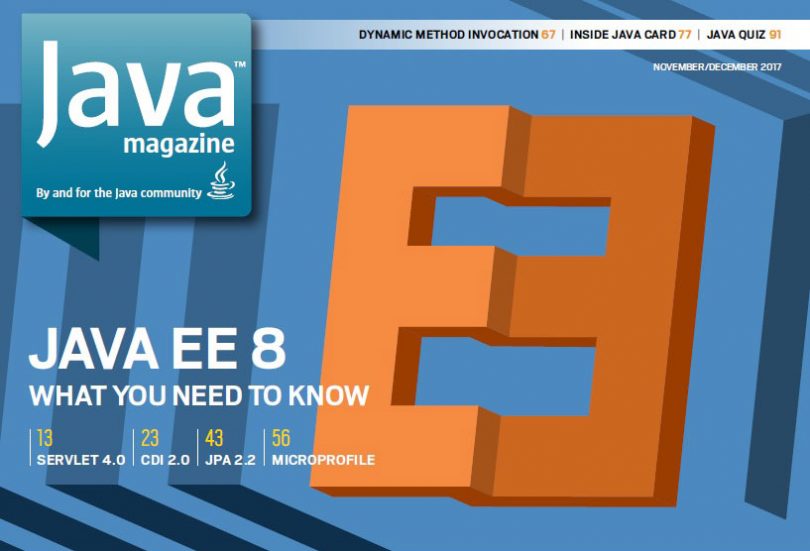

“Java Magazine” jurnalının 2017-ci il Noyabr/Dekabr buraxılışında OCA (intermediate) və OCP (advanced) Java SE 8 imtahanı ilə əlaqəli 4 maraqlı sual paylaşılıb:
Question 1 (intermediate). Given this code:
int a = 012; // line n1
int b = 12;
int c = Integer.parseInt("012", 10);
and these statements:
a == bb == ca == cLine n1causes a compilation error.
Which is true? Choose one.
A. 4 only
B. 1, 2, and 3
C. 1 only
D. 2 only
E. 3 only
Question 2 (intermediate). Given this fragment (shown with line numbers):
14: long i1 = 1234567890123456789;
15: short s1 = 99, s2 = 100, s3 = s1 + s2;
16: float pi = 3.14;
17: short s = 199;
Which is true? Choose one.
A. Lines 14 and 16 are correct, but lines 15 and 17 cause compilation to fail.
B. Lines 14 and 15 are correct, but lines 16 and 17 cause compilation to fail.
C. Lines 15 and 17 are correct, but lines 14 and 16 cause compilation to fail.
D. Line 17 is correct, but lines 14, 15, and 16 cause compilation to fail.
E. Line 14 is correct, but lines 15, 16, and 17 cause compilation to fail.
Question 3 (advanced). Given that the following declaration has been properly initialized to refer to a List implementation that contains multiple String objects, and that your intention is to remove from the list all strings that start with *:
List<String> ls;
Which of the following are true? Choose two.
A. The items can properly be removed by using this code:
[nbsp count=4]for (String s : ls) {
[nbsp count=8]if (s.startsWith("*")) ls.remove(s);
[nbsp count=4]}
B. The items can properly be removed by using this code:
[nbsp count=4]ls.forEach(s->{if (s.startsWith("*")) ls.remove(s);});
C. The items can properly be removed by using this code:
[nbsp count=4]ListIterator<String> lis = ls.listIterator();
[nbsp count=4]while (lis.hasNext()) {
[nbsp count=8]if (lis.next().startsWith("*")) lis.remove();
[nbsp count=4]}
D. The items can properly be removed by using this code:
[nbsp count=4]int last = ls.size();
[nbsp count=4]for (int idx = 0; idx < last; idx++) {
[nbsp count=8]if (ls.get(idx).startsWith("*")) {
[nbsp count=12]ls.remove(idx);
[nbsp count=8]}
[nbsp count=4]}
E. Given the information available, it’s not possible to guarantee that the removal will succeed.
Question 4 (advanced). Given the following code:
Optional
[nbsp count=4].<String>ofNullable(null)
[nbsp count=4].flatMap(x->x != null ? Optional.of("A") : Optional.of("B"))
[nbsp count=4].map(String::toLowerCase)
[nbsp count=4].ifPresent(System.out::println);
Which is true? Choose one.
A. The output is a.
B. The output is b.
C. Replacing the flatMap call with .orElseGet(()->Optional.of("C")) results in the output c.
D. The code runs but produces no output.
E. Replacing the call to flatMap with .map(x->x != null ? "A" : "B") results in the output b.
- D
- D
- C, E
- D
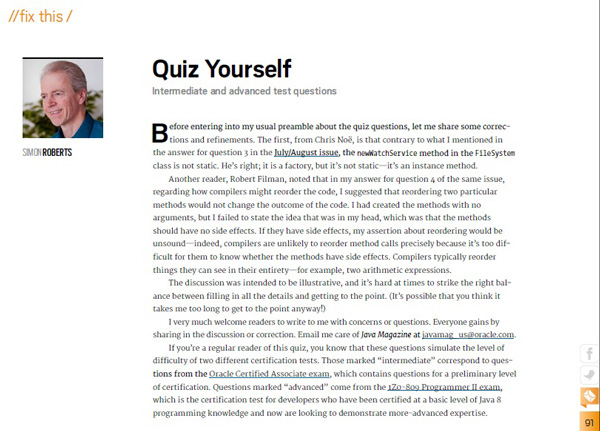
Suallar Simon Roberts tərəfindən ətraflı şəkildə izah edilmişdir. İzahlara yazının aşağıdakı orijinal linkinə klikləyərək baxa bilərsiniz:
| Nov/Dec 2017 | |
|
|
| page 91 | Table of Contents |